The “Topical Bridge”: A Semrush Workflow for Your First Aged Domain Post


The “First Post” Problem: Reclaiming Authority
In our past few articles, we’ve completed the full journey of an advanced domain investor.
- We found
acmetech.comusing the “Digital Archaeologist” method. - We built a content plan by analyzing competitors.
- We even created a link-building roadmap.
Now, we’re at the most critical moment. We have to write our very first article on this new mini-site.
This post is a “make or break” moment. Its job is to signal to Google that our new site is a legitimate, high-quality continuation of the old site’s authority. We must build a “Topical Bridge” from the domain’s old “ghost topic” to our new, modern content.
In my guide on how to build your first “mini-site”, I explained why this is important (Step 4 in that post). Now, I’m going to show you how I do it with a hands-on workflow using my new tool, Semrush Guru, and its powerful Content Marketing Toolkit.
Step 1: Find the “Ghost Topic” & Its Modern Bridge
From our “Digital Archaeologist” audit of acmetech.com, we know its authority comes from one specific source: a 2005-era WordPress plugin called “AdSense-Deluxe.”
- Ghost Topic:
AdSense-Deluxe WordPress Plugin - Modern “Bridge” Topic:
WordPress monetization
I can’t write about an obsolete plugin from 2005. I must find a modern keyword that is topically related to “WordPress monetization” that my new site (with its DR 30 head start) can realistically rank for.
Step 2: Find a Winnable “Bridge” Keyword (Semrush Keyword Magic Tool)
This is where I turn to the Semrush Keyword Magic Tool. My goal is to find a low-competition, high-intent keyword that acts as our bridge.
Here is my exact workflow:
- Seed Keyword: I enter our broad “bridge” topic:
wordpress monetization. - Filter by Intent: I select “Informational” intent. I want to find “how-to” or “best-of” queries, which are perfect for a first pillar post.
- Filter by Difficulty: I select “Easy” (KD 15-29%). This removes high-competition keywords and shows me what a new site can actually rank for.
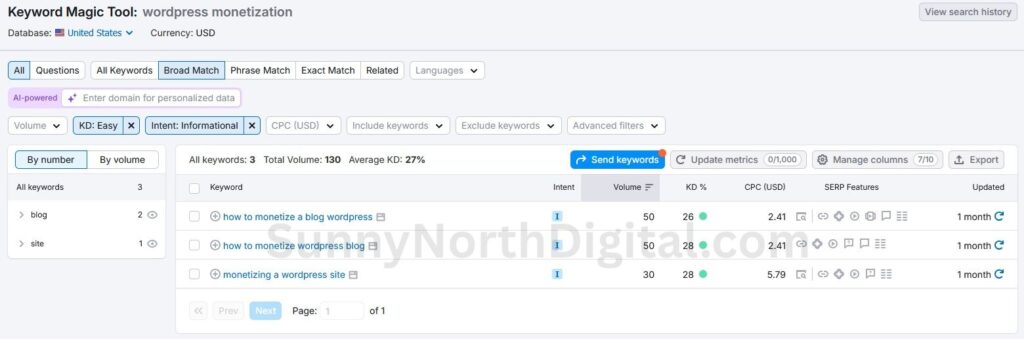
wordpress monetization by “Informational” intent and “Easy” KD to find winnable, long-tail keywords.Analytical Insight: The tool instantly gave me three perfect targets. I’m choosing how to monetize a blog wordpress (Vol 50, KD 26). It’s the lowest difficulty, has clear user intent, and is a perfect topical bridge to my domain’s “AdSense-Deluxe” history. This will be my first pillar post.
Step 3: Build the Content Blueprint (Semrush SEO Content Template)
Now that I have my target keyword, I won’t just start writing. I’ll use the Semrush SEO Content Template tool (a key feature of the Guru plan) to build a data-driven “blueprint.”
I simply enter my chosen keyword (how to monetize a blog wordpress) and the tool analyzes the current top 10 Google results for me.

Step 4: The AI-Proof Analysis (Deconstructing the Blueprint)
This report is the “AI-Proof” part of the process. It’s an expert-level brief that an AI cannot generate on its own. It tells me exactly what I need to do to create a top-ranking article.
Semantically Related Keywords
This is the most valuable part. Semrush lists the keywords Google expects to see in a comprehensive article on this topic.

Analytical Insight: This is pure gold. An AI or a junior writer would just write about “monetizing.” This data tells me I must specifically discuss affiliate marketing, selling digital products, membership sites, and even google adsense (our original “ghost topic”!). My article outline is now practically writing itself.
Competitor Analysis & Text Length
The tool also tells me what I’m up against.

Analytical Insight: My plan for a quick 800-word post is dead. The data shows that to compete, I must write a comprehensive, long-form guide of over 2,300 words. This insight alone saves me from publishing a post that would be doomed to fail.
Backlink Targets
As a bonus, the template even starts my link-building for me.

Analytical Insight: This list feeds directly into the workflow I outlined in my guide to building your first 10 links. I can now target these domains for my own outreach.
Step 5: The Final Blueprint (SEO Writing Assistant)
The last step is to bring it all together. I can export this entire brief or, even better, open it directly in the Semrush SEO Writing Assistant.
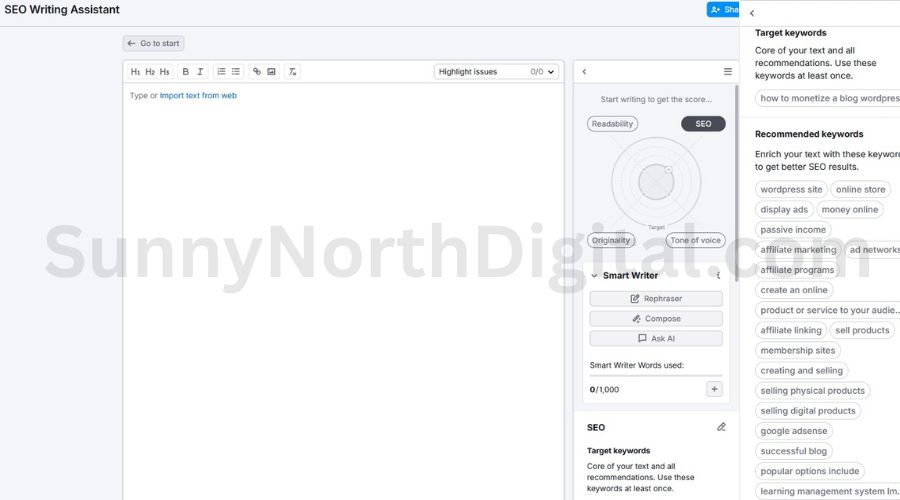
Analytical Insight: This is the final blueprint. I can now write the article myself (or hand this brief to a writer) and be 100% confident that the final piece is perfectly optimized. It will be the right length, hit all the right semantic keywords, and be topically aligned with my aged domain’s authority.
You Are the Architect
This workflow is how you create “AI-Proof” content that ranks. You are not just a writer; you are an expert architect.
By using an aged domain’s Ghost Topic as your starting point, you can use the Semrush Keyword Magic Tool to find a modern “Bridge” keyword. From there, the SEO Content Template builds a perfect, data-driven blueprint.
This plan ensures your very first post on your new mini-site successfully re-establishes topical authority, reclaims your “link juice,” and starts your journey to ranking a new, profitable digital asset.
But a single pillar post is just the start. Your next step is to build the surrounding ‘spoke’ articles. Learn my exact workflow in this guide to building a full topic cluster.
Once your content is live, don’t just wait and hope. Use my Semrush workflow for tracking your new site’s SEO progress to see exactly how Google is responding to your new pillar post.