The “Developed Flip” Audit: Pricing and Selling Your Mini-Site for Maximum Value


The Final ROI
You’ve mastered the art of finding, vetting, and launching a profitable mini-site on an aged domain. You have spent months building out your content clusters, acquiring your first links, and watching your Visibility % grow.
Now comes the final—and most lucrative—step in the investment lifecycle: The Developed Flip.
A raw expired domain might be worth $500. A developed asset earning $200 per month can sell for $6,000–$8,000. Your goal in this phase is to turn your monthly passive income into a massive, one-time capital gain.
But how do you ensure you get the maximum multiple? The answer is: You must audit and prove the asset’s worth like a professional broker.
In this guide, I’ll walk you through my three-part “Developed Flip” Audit workflow, focusing on the core financial metrics and technical clean-up necessary to justify a premium sales price. This is the difference between getting 25x profit and 40x profit.
Step 1: The Core Financials (Calculating SDE)
The first step of any profitable sale is ignoring gross revenue. Buyers from Empire Flippers, Acquire.com, and other platforms only care about Seller’s Discretionary Earnings (SDE).
This is the real core cash flow of the business.
What is SDE?
SDE is the profitability figure used for valuing small to mid-sized online businesses. It takes your net profit and adds back legitimate, non-recurring business expenses that a new owner won’t incur.
Tool: Semrush Topic Research
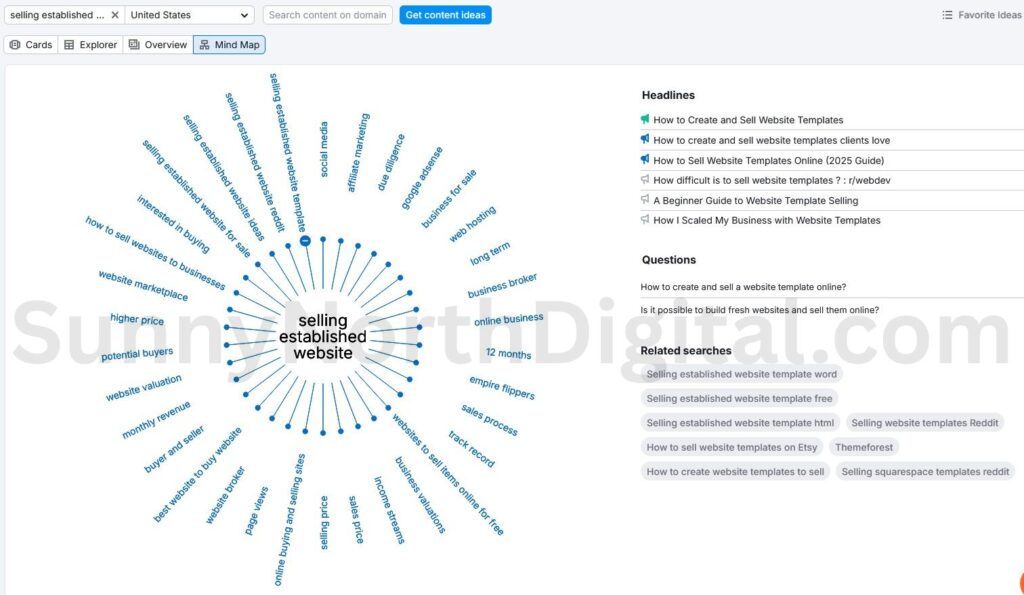
Workflow: To uncover the critical financial and marketplace questions buyers ask, our audit begins with Semrush’s Topic Research tool. Entering “selling established website” reveals the exact sub-topics and questions we need to address in our valuation model, such as “How much should I sell my websites for?” and “What is SDE?”.
Analytical Insight:
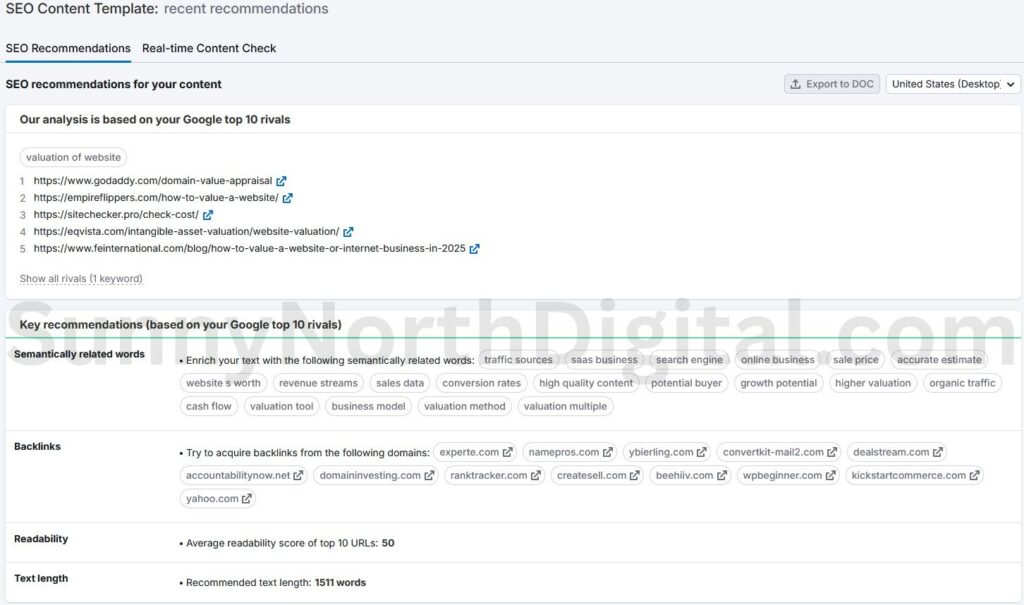
The data from Semrush Topic Research, and subsequently validated by the Content Template, confirmed that to rank for this topic, you must use financial terms like cash flow, revenue streams, and adjusted net profit. These are the keywords buyers look for in a professional valuation.
- Net Profit: All revenue (affiliate commissions, ad networks) minus hosting, software fees, and operational costs.
- Add-Backs: You add back expenses that are optional or personal: your own salary, one-time software purchases, discretionary travel, and personal expenses run through the business.
The result: Your SDE is the true adjusted profit number. Every professional valuation multiple (e.g., 35x monthly SDE) is calculated using this SDE figure.
Step 2: Maximizing the Multiple (The SEO Justification)
The current valuation multiple for affiliate and content-based online businesses often ranges from 30x to 40x monthly SDE. Your job is to justify the higher end of that range.
The Competitors (The Market Trap):
Marketplaces like GoDaddy, Flippa, and Sitechecker offer instant, black-box website valuation estimates. These automated tools miss the most critical factors that determine a high sale price. They see keywords; they don’t see stability.
Buyer Concern: A smart potential buyer knows that traffic is volatile. They need proof of stable, long-term organic traffic.
Your Solution: You don’t just sell the traffic; you sell the system that creates it.
Proving Authority and Growth Potential
You must present specific data to answer the buyer’s question: “Is this asset defensible?”
- Topical Authority: Present the map of your topic cluster strategy. Show how your pages are internally linked and how you dominate the niche (not just one keyword). This proves long-term stability and growth potential.
- Link Quality: Highlight your backlink profile (using data from Post #14). Show that your most valuable links are high quality content citations, not toxic spam.
- Active Maintenance: Show the buyer the results of your “Plateau Breaker” Audit. Presenting a plan to fix content decay is a massive selling point that justifies a higher valuation.
Tool: Semrush Keyword Magic Tool
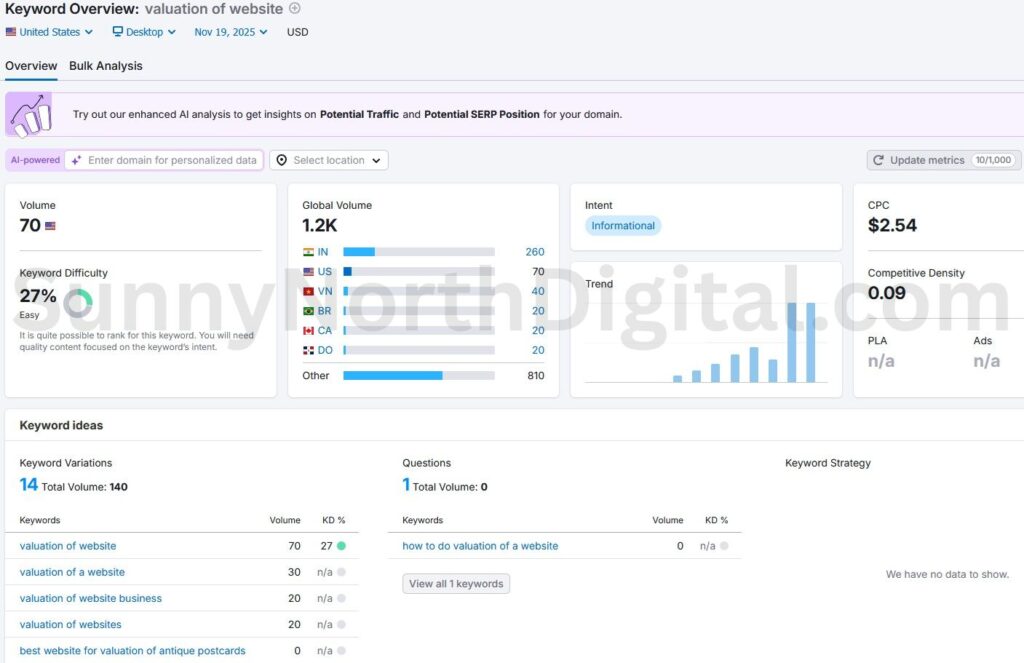
Workflow: Before committing to a content blueprint, we confirmed our primary keyword, “valuation of website,” had a winnable Keyword Difficulty (KD 27%).
Step 3: The Technical Clean-Up (Adding Value Before Sale)
Before you list the asset, you must address any outstanding technical issues that a broker’s due diligence team will flag. Fixing these adds immediate value and justifies a higher sale price.
- Fix Content Decay: Run the Plateau Breaker Audit one last time. Update the titles and publish dates of your top-ranking pages. Clean, updated content reduces the buyer’s risk.
- Address 404s/Redirect Chains: Ensure there are no broken links (404s) on your highest authority pages, or that any necessary 301 redirects are in place. This prevents link equity from leaking. (This is the ultimate decision from my “Authority Merger” audit).
- Clean Analytics: Ensure all traffic is recorded accurately in Google Analytics (GA4) and Google Search Console. High-quality content and transparent traffic sources are essential for trust.
Tool: Semrush SEO Content Template
Workflow: The final step of our audit is to generate a comprehensive content blueprint. This ensures our guide covers every essential detail a buyer or broker would expect, building ultimate authority.
Your Exit Strategy
The Developed Flip is the highest form of domain flipping because you are selling a predictable business model, not just a domain name.
By building your cash flow and actively demonstrating the asset’s security and growth potential through data, you move your website’s worth out of the realm of automated guesses and into the realm of professional investment. This is how you secure that premium valuation multiple and achieve the maximum ROI on your initial domain investment.