An Expert’s Glossary of 25+ Domaining & SEO Terms

Feeling lost in a sea of SEO jargon like DR, DA, PBN, and EMD? You’re not alone. The world of domain investing has its own language, and understanding these SEO terms is the first step to making profitable decisions.
An AI can give you a basic definition, but it can’t tell you what these terms mean in the real world of buying and selling digital assets.
This guide is your one-stop resource. We’ll break down all the key domaining terms you need to know in plain English, with expert insights on why each one matters. In the end, you’ll be able to analyze domains with the confidence of a pro.
Key Authority Metrics
These are the core scores that SEO professionals and domain investors use to get a quick read on a domain’s power and trustworthiness.
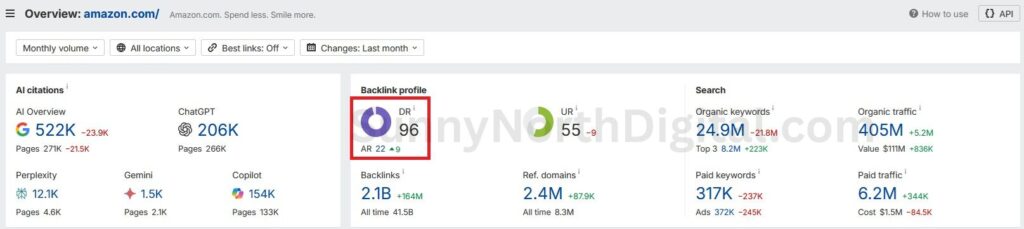
Domain Rating (DR)
- Definition: Domain Rating (DR) is a proprietary metric from Ahrefs that measures the strength of a website’s backlink profile on a logarithmic scale from 0 to 100.
- Why it Matters: DR is one of the first metrics an investor checks. A higher DR generally indicates a more authoritative domain that can rank content more easily. However, it’s just a starting point—a high DR with spammy links is worthless.
Domain Authority (DA)
- Definition: Domain Authority (DA) is a similar metric from Moz that predicts a website’s ranking potential.
- Why it Matters: DA is a well-known legacy metric. While many technical SEOs now prefer DR for its correlation with rankings, you will still see DA used frequently in domain marketplaces. It’s important to know what it is.
URL Rating (UR)
- Definition: Another Ahrefs metric, URL Rating (UR) measures the strength of a specific page’s backlink profile, not the entire domain.
- Why it Matters: When evaluating a domain, you might find a specific page (like an old blog post) has an incredibly high UR because it attracted a lot of links. This can be a sign of a high-value page you can leverage.
Essential Backlink Terminology
Backlinks are the currency of the web. Understanding their language is non-negotiable for any domain investor.
Backlink
- Definition: A backlink is a link from one website to another.
- Why it Matters: For an investor, a high-quality backlink profile is the primary asset you are acquiring. Powerful, relevant backlinks are what give an aged domain its value.
Dofollow vs. Nofollow
- Definition: A “dofollow” link passes SEO authority (“link juice”) to the target site. A “nofollow” link has a special tag that tells Google not to pass authority.
- Why it Matters: While dofollow links are what primarily boost a site’s DR, you should never ignore nofollow links. In fact, nofollow links from highly authoritative sites like Wikipedia can be incredibly powerful trust signals that tell Google your site is a legitimate resource. We saw this exact scenario play out in my deep-dive audit of a real expired domain, which you can read in full here.
Anchor Text
- Definition: The clickable words in a hyperlink (e.g., “click here”).
- Why it Matters: The anchor text profile tells you how other sites see your domain. A natural profile has a healthy mix of branded and generic terms. A profile full of spammy, exact-match keywords is a major red flag.
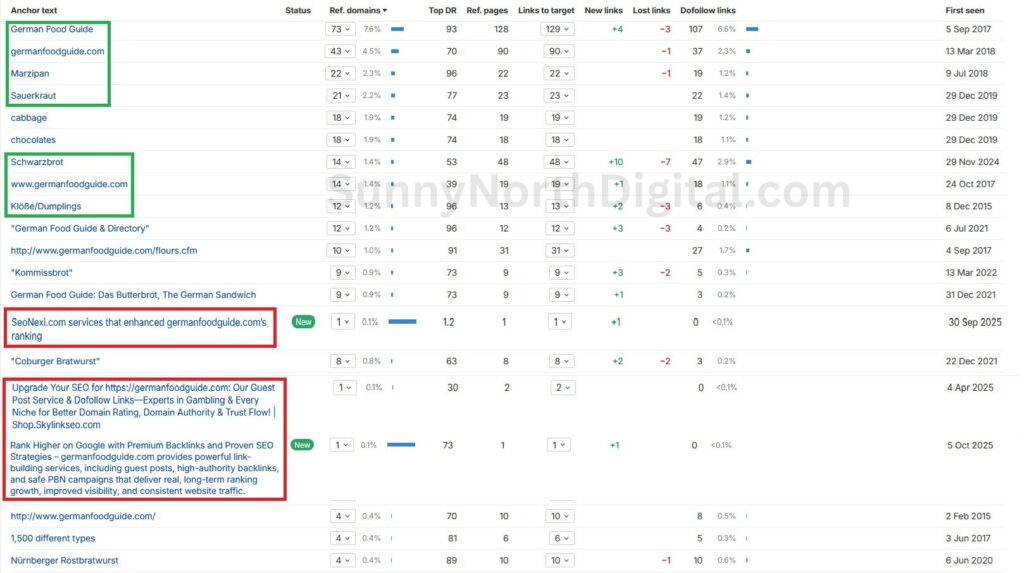
The germanfoodguide.com anchor text profile is a perfect example of a mixed-quality asset. It has a fantastic foundation of natural, branded, and topically relevant links, which shows it was once a legitimate authority. However, this strong profile has been tarnished by subsequent low-quality and spammy link-building efforts.
For a potential investor, this domain has real value, but it comes with a significant cleanup project. The first step for a new owner would be to conduct a full backlink audit and submit a disavow file to Google to tell it to ignore the spammy links.
Referring Domains
- Definition: The unique websites that have linked to your target domain.
- Why it Matters: 100 links from 100 different domains is far more valuable than 100 links from a single domain. A high number of unique referring domains is a sign of a diverse and robust backlink profile.
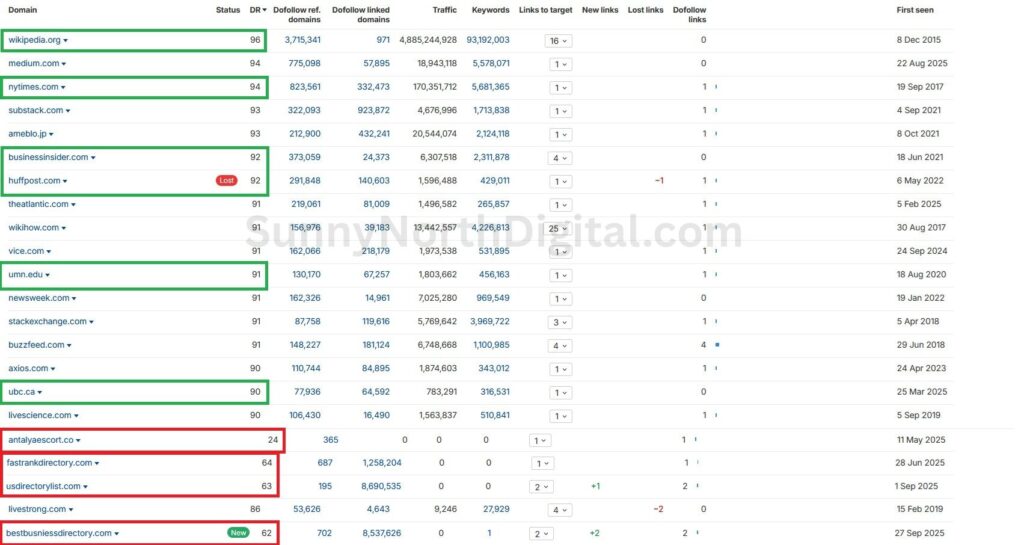
The germanfoodguide.com referring domains report shows a domain with a “blue-chip” foundation and a significant spam problem. On one hand, it has earned links from some of the most authoritative sites on the web, like Wikipedia and The New York Times, which is incredibly valuable.
On the other hand, this stellar profile is being severely diluted by a huge volume of low-quality directory spam and some toxic, irrelevant links.
For an investor, this means the domain has a powerful, salvageable core. However, a significant cleanup project would be mandatory.
The first and most critical task for a new owner would be to perform a full backlink audit, identify all the spammy referring domains, and submit a comprehensive disavow file to Google to ask it to ignore these harmful links.
Private Blog Network (PBN)
- Definition: A PBN (Private Blog Network) is a network of websites created for the sole purpose of building links to a central “money site” to manipulate its rankings.
- Why it Matters: Using PBNs is a black-hat SEO tactic that violates Google’s guidelines. When you’re auditing a domain, identifying that its backlinks are coming from a PBN is a critical warning sign. Acquiring a domain propped up by PBN links is extremely risky, as it’s likely to be penalized. Learning how to spot a domain that has been part of a PBN is a critical skill for any investor.
Domain Status & Types
These terms describe a domain’s lifecycle as it goes from active to available.
Expired Domain
- Definition: A domain that the previous owner has not renewed, making it available for a new registration.
- Why it Matters: This is the primary target for domain investors, as these domains often retain their previous SEO authority.
Dropped Domain
- Definition: A domain that has gone through the full expiration and redemption process and has been “dropped” back into the public pool for anyone to register.
- Why it Matters: Drop catching services specialize in grabbing these domains the second they become available.
Redemption Period
- Definition: A grace period (usually 30 days) after a domain expires where the original owner can still renew it, often for a higher fee.
- Why it Matters: You cannot acquire a domain until it has passed through this period.
Pending Delete
- Definition: The final, short phase (usually 5 days) after the redemption period where the domain is queued for deletion and will soon be dropped.
Auction & Business Terms
These terms relate to the business of buying and selling domains.
Domain Flipping
- Definition: The business model of buying domains with the intention of selling them for a profit.
- Why it Matters: This is the core activity of most domain investors. For a complete introduction to the business model, the different strategies, and its profitability in 2026, I recommend starting with my beginner’s guide on what domain flipping is.
Domain Backorder
- Definition: A service offered by registrars where you can place a “backorder” on an expiring domain. The service will attempt to automatically register it for you if it becomes available.
- Why it Matters: It’s a key tool for acquiring competitive domains.
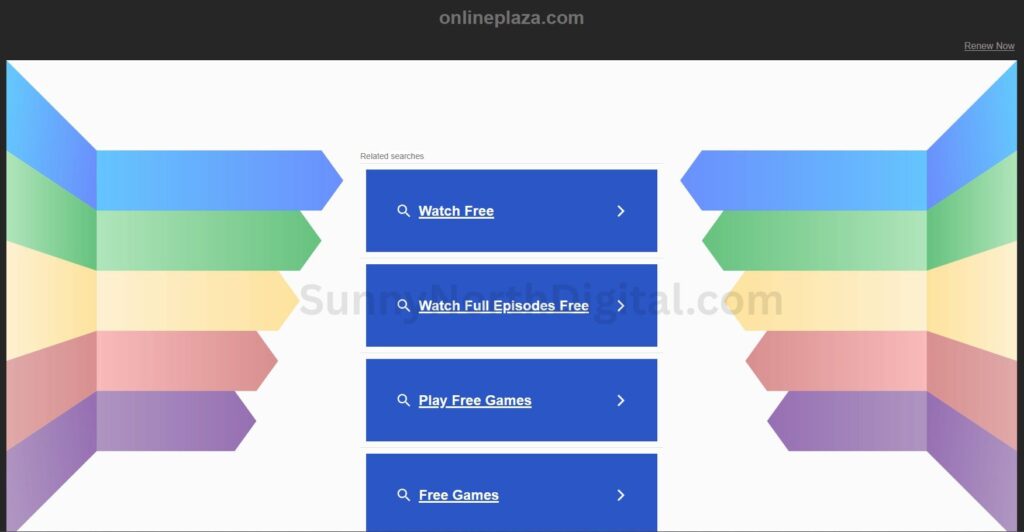
Domain Parking
- Definition: The practice of placing advertisements on an unused domain to generate passive income while you wait for a buyer.
- Why it Matters: This is one of the simplest domain monetization options for a portfolio of domains you aren’t actively developing.
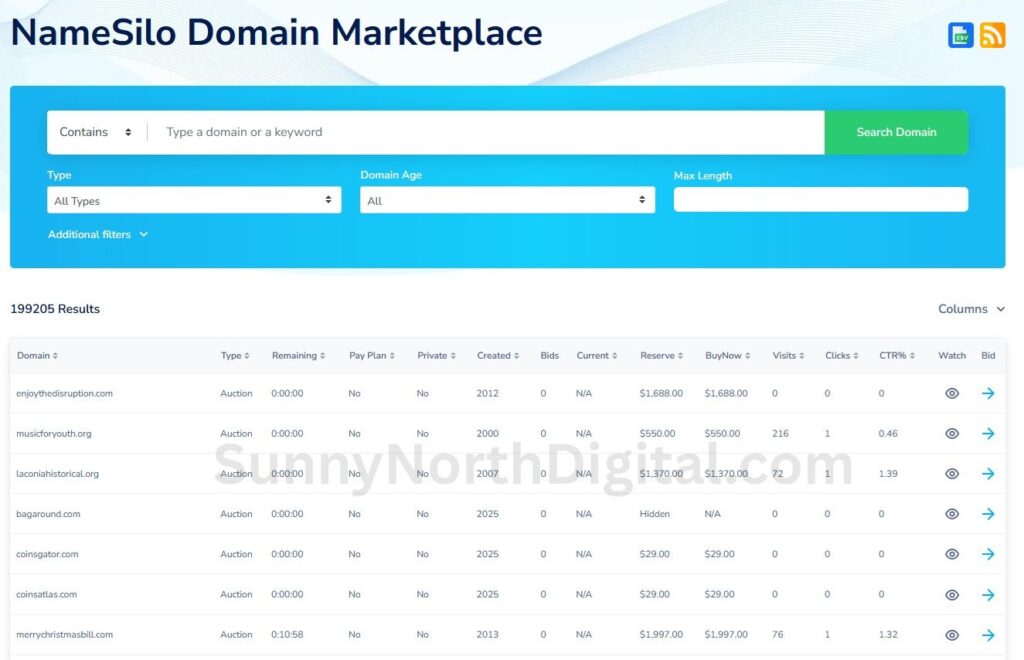
Domain Marketplace
- Definition: A platform where you can buy and sell domains, either through auctions or fixed-price listings.
- Why it Matters: Knowing the top platforms is essential for finding quality inventory. While there are dozens of marketplaces, each has its own pros and cons. To help you get started, I’ve created a detailed review of the best domain auction sites for beginners.
Mini-Site
- Definition: A small, 5-10 page website built on an aged domain. In domain investing, this is often done to prove the domain’s ability to rank and generate traffic before “flipping” it for a higher profit.
- Why it Matters: Building a mini-site is the core of the “Develop and Sell” strategy. I’ve written a complete guide on how to build your first mini-site that walks you through the entire process.
Domain Appraisal Tools
- Domain Appraisal Tool:
- Definition: An automated tool that attempts to assign a monetary value to a domain name based on factors like length, keywords, and sales data.
- Why it Matters: These tools are popular but can be very inaccurate. I tested the most popular ones in my GoDaddy and EstiBot appraisal review.
- GoDaddy Appraisal (GoValue):
- Definition: The most popular free domain valuation tool, known for being very optimistic.
- Why it Matters: It’s a quick way to get a baseline idea, but its results should not be trusted for high-stakes purchases. See my full test on its accuracy for why.
From Terms to Takeaways
Understanding this SEO vocabulary is the first step to moving from a novice to a confident domain investor.
When you can speak the language, you can analyze assets more effectively and make smarter, more profitable decisions.