The “Authority Merger” Audit: When to (and NOT to) 301 Redirect an Expired Domain


The “Rebuild vs. Redirect” Dilemma
In the “Digital Archaeologist” method, we took an expired domain (acmetech.com) and created a strategic plan to rebuild it as a new mini-site. This is a powerful way to create a new, cash-flowing asset from scratch.
But what if you don’t want a new site? What if you already have a “money site” and just want to boost its authority?
This brings us to the second, most-debated strategy in domain investing: The 301 “Authority Merger.”
The idea is simple: buy an aged domain with a high DR and 301 redirect it to your main site, hoping to pass all that “link juice” and boost your rankings. It’s faster than a rebuild, but it’s also much riskier. An AI can tell you how to implement a redirect, but it can’t perform the nuanced, high-stakes analysis to see if you should.
A failed redirect can, at best, be ignored by Google, wasting your money. At worst, it can send spammy signals to your money site and damage its reputation.
So, how do you know if it’s safe? You perform an “Authority Merger Audit.”
Let’s run a real case study. I want to boost my own blog, sunnynorthdigital.com. I “found” the same DR 30 domain, acmetech.com, at auction. Can I just 301 redirect it to my blog and enjoy a DR 30 boost? Let’s run the audit and find out.
Step 1: The “Money Site” Target Analysis
First, I’ll identify a “money page” on my own blog, sunnynorthdigital.com, that I want to boost. This will be our target for the “Authority Merger.”
Now, let’s look at my Top Pages report in Ahrefs.

Analytical Insight: Ahrefs Data Lag vs. GSC Reality
Let’s pause on this screenshot. A beginner might see ‘0 traffic’ and think my site is a failure. As an expert, I know this is a perfect example of Ahrefs data lag.
Ahrefs is not Google; it’s a third-party crawler, and it can take weeks or months to fully index a new site and its rankings. My actual data from Google Search Console (which I shared in a previous update) shows 528 impressions in that same timeframe.
This is a critical lesson: Always trust your own Google Search Console for real-time performance data on a new site.
For this case study, the Ahrefs ‘0’ is irrelevant. We know from GSC that my post https://sunnynorthdigital.com/5-proven-ways-to-monetize-an-expired-domain/ is one of my core “pillar” pages. This is the page I want to boost.
My target page’s topic is clearly about modern domain monetization strategies. This is the ‘topic’ I must match.
Step 2: The Expired Domain’s “Pillar Page” Analysis
Now, let’s look at our expired domain, acmetech.com. We need to find what it has authority for. We can’t just look at the homepage; we need to find the specific pages that earned its backlinks.
Tool: Ahrefs Best by links (for acmetech.com) + Wayback Machine.
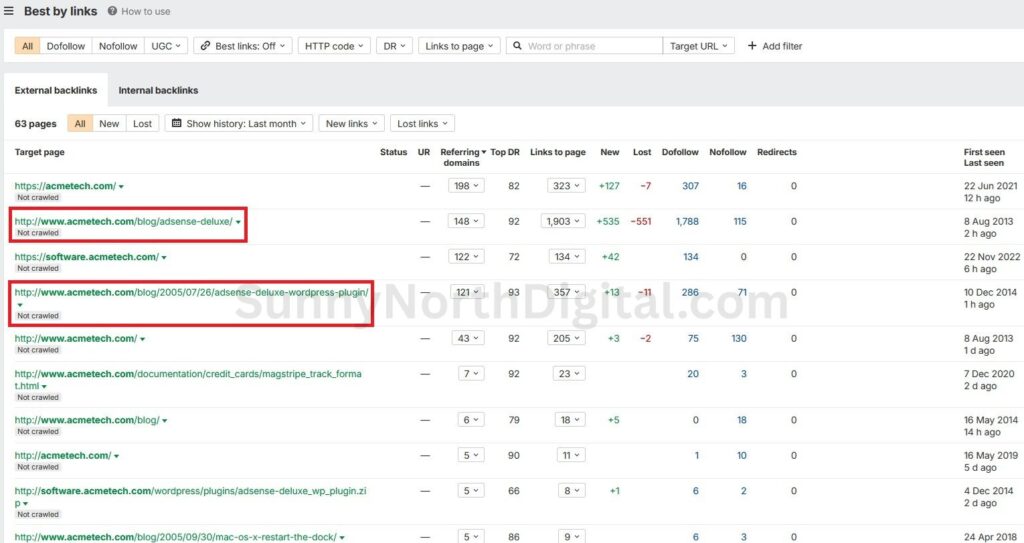
The data is crystal clear. The VAST majority of this domain’s authority comes from one specific piece of content: a WordPress plugin called “AdSense-Deluxe” from 2005.
Let’s verify this with the Wayback Machine.
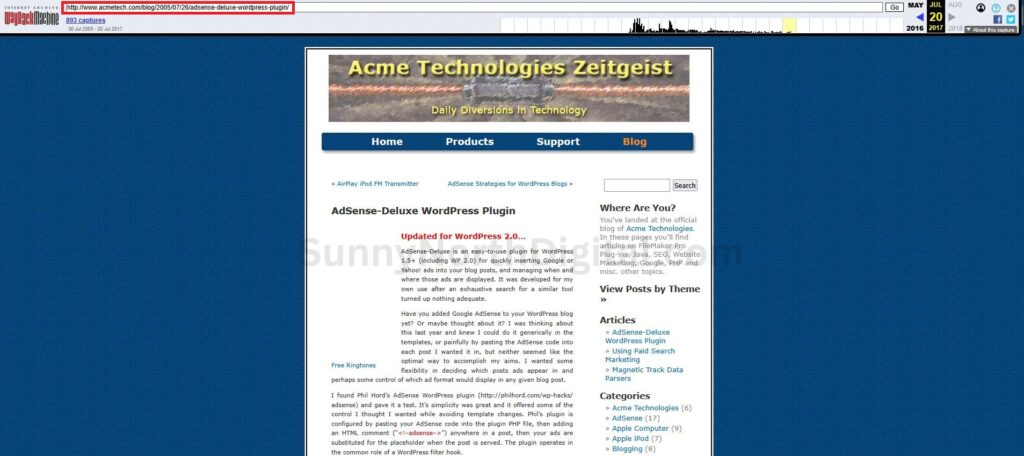
This confirms our analysis. The expired domain’s actual authority isn’t “general tech”—it’s hyper-specific: an outdated WordPress plugin for AdSense from 2005.
Step 3: The Topical Relevance Audit (The Go/No-Go Decision)
This is the core “AI-Proof” analysis, the strategic judgment call that a simple tool can’t make. We must now compare the two topics side-by-side.
- Topic A (My Money Site Target):
https://sunnynorthdigital.com/5-proven-ways-to-monetize-an-expired-domain/- User Intent: A domain investor in 2026 looking for a high-level strategic guide on what to do with their new asset (flip, build, redirect, etc.).
- Topic B (The Expired Domain’s Pillar):
http://www.acmetech.com/blog/adsense-deluxe/- User Intent: A blogger in 2005 looking to download a specific WordPress plugin to manage AdSense ads.
Now, let’s ask the critical questions:
- Are they a 1:1 match?
- No. One is a modern strategic guide; the other is an ancient, obsolete product page.
- Is the user intent the same?
- Absolutely not. A user who originally linked to a plugin download (Topic B) has zero interest in a strategic guide on domain flipping (Topic A).
- Is the topic “closely related”?
- Barely. You could argue they both involve “WordPress” and “Monetization,” but the context, audience, and intent are from different decades. The link from
blog.hubspot.comtoacmetech.comisn’t about domain strategy; it’s about a specific plugin.
- Barely. You could argue they both involve “WordPress” and “Monetization,” but the context, audience, and intent are from different decades. The link from
Step 4: The Final Verdict: DO NOT REDIRECT (This Is the Expert Insight)
This “Authority Merger” audit is a RESOUNDING FAILURE.
Redirecting acmetech.com to sunnynorthdigital.com would be a classic, costly amateur mistake. Here is exactly what would likely happen if I did:
- Risk 1: Devalued Links: Google’s algorithm isn’t stupid. It would see the massive topical mismatch between the content that earned the links (an AdSense plugin) and my target page (a guide to monetization). It would likely treat the redirect as a “soft 404” and pass zero link equity.
- Risk 2: Bad User Experience: Any real user (or crawler) following an old link to
acmetech.comexpecting a plugin would be confused when they land on my monetization guide. This creates a high bounce rate and signals to Google that my page is a poor match for those links. - Risk 3: Spam Signals: At worst, this looks like a manipulative attempt to “pass juice” from an irrelevant domain. This is the exact kind of behavior Google penalizes. Before ever attempting a 301, you must be sure you’re not dealing with a penalized or spammy domain to begin with.
The Verdict: The risk is high, and the potential reward is almost zero. The topical match is far too weak.
The Correct Strategy for acmetech.com
Our audit proved that acmetech.com is a “Rebuild” candidate, not a “Redirect” candidate.
The only safe and profitable way to use this domain’s authority is to follow the “Digital Archaeologist” method:
- Rebuild a new mini-site on
acmetech.comitself. - Honor the Topic: Build the site around the original authority: “WordPress,” “WordPress Plugins,” “AdSense,” and “Monetization Tech.”
- Analyze Competitors: Run an Ahrefs competitor analysis against modern sites like WPBeginner and Kinsta to create a relevant content plan.
- Monetize: Use that new site to generate revenue via modern affiliate links (e.g., “Best AdSense Plugins 2026,” “WP Rocket vs. FlyingPress”).
The “Authority Merger” is a powerful tool, but only for a near-perfect 1:1 topical match. This audit proves that knowing when to walk away from a redirect is the most important part of the strategy.
The very first step of that ‘Rebuild’ is to create a new pillar post that bridges the old authority. You can see my full Semrush workflow for that exact process here.